The disguise
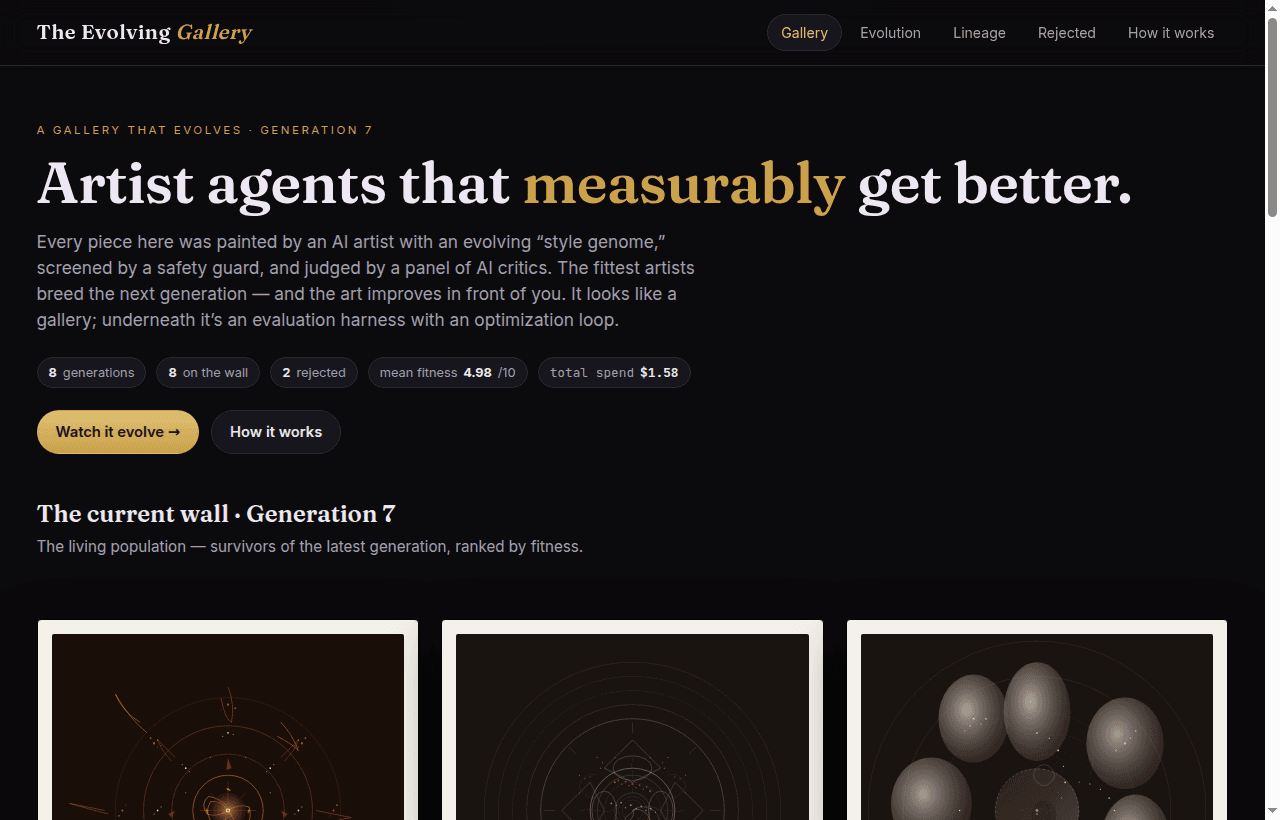
On the surface this is an art gallery: a wall of generative pieces, each with a name, a fitness score, and four AI critics arguing about it. Hit Evolve and the art visibly improves generation over generation; trace any masterpiece's family tree back to its gen‑0 ancestors.
Underneath, it's the machinery that keeps real AI agents from silently rotting: a measurement harness, deterministic guardrails, an LLM judge panel, and a human‑in‑the‑loop optimization loop. I built it on art instead of a boring enterprise workflow so it's actually memorable - but every competency on display is the one the hard AI jobs are really asking for.
One generation, end to end
Each artist is an LLM with an evolving style genome - a natural‑language aesthetic ("brutalist geometric forms in a muted 4‑color palette with heavy negative space") plus a few numeric knobs. A generation runs four stages:
- Generate. Every artist writes a self‑contained SVG.
- Guard - the reliability layer, made literal. Each SVG runs a deterministic
gauntlet: parses as XML? no
<script>, event handlers, external URLs, orforeignObject? enough drawable shapes? under 50 KB? survives a DOMPurify sanitize? renders headless (resvg) without error? A failure is disqualified with a reason and sent to the rejected sketches drawer. This is the "AI code that silently breaks" story, caught and shown instead of hidden. - Judge. Survivors are rasterized and scored by a panel of AI critics across three providers (Claude Haiku, Gemini Flash, GPT‑4o‑mini) - genuinely different eyes, each rating one lens 0–10 with a one‑line verdict.
- Evolve. Fitness (a transparent blend of critics, human votes, and a novelty bonus) selects the fittest; their genomes are mutated and cross‑bred into the next population.
The part a pure eval harness never has
Measurement alone tells you whether an agent got worse. The interesting half is closing the loop so it gets better. The optimizer here does that with one honest trick: the critics' feedback steers the artists. When an artist survives or mutates, it repaints while seeing its own previous critiques - "composition faulted this for X; address it." That's the measure→improve loop, in context.
It works, and the numbers are real, not staged. Across a live 8‑generation run:
- Critic quality climbed 5.4 → 6.5 as artists refined on feedback.
- Novelty declined 4.2 → 3.0 - honestly, because the population converged on winning styles (the classic exploration/exploitation tension, shown rather than hidden).
- 64 pieces generated, 2 rejected by the guard, $1.58 total - every call metered.
Cost, measured - not asserted
Cheap models by default. To prove the expensive tier earns its place, I ran the same seed genomes on Claude Haiku and Claude Sonnet and judged both: Sonnet buys about +0.4 quality for 2× the cost. So the gallery defaults to Haiku - a decision made from a measurement, not a vibe. That honesty about the cost↔quality tradeoff is the whole point.
How it's built
- Frontend: Next.js 15 (App Router, TypeScript) on Vercel - a museum‑styled masonry wall, per‑piece critic panels and fitness breakdowns, an interactive Evolve theatre where the fitness curve draws generation by generation, a lineage family tree, and the rejected‑sketches drawer.
- Engine: a TypeScript pipeline over OpenRouter (one key, many models): artist runner with per‑call cost accounting, the guard (DOMPurify + resvg), the vision judge panel, structural‑novelty scoring, and the critic‑steered evolution engine. It runs offline and commits real, static data so the wall is full on first paint - the art you see was really generated and really judged.
The measurement half is a clean‑room, public rebuild of a private agent‑eval engine I'd already built (deterministic asserts, a live cost table, run persistence, generation‑to‑generation A/B compare). This project adds the optimization loop that one never had - and dresses the whole thing in something people actually want to look at.